I See What You Want:Decoding Hierarchical Operator Intent
from Visual Teleoperation History

Xiangyi Jia1Kaixian Qu1Shengzhi Wang1,2Chenyu Yang1Robert Katzschmann1Marco Hutter1
1 ETH Zurich2 Chinese University of Hong Kong

Abstract

Vision-language models (VLMs) have become a powerful foundation for robotic scene understanding, task planning, and language-conditioned control. A natural question follows: can these models also decode what a human operator intends while teleoperating a robot, without any explicit instruction? We formulate this as hierarchical intent prediction, jointly inferring the ongoing atomic action and the broader mission it serves from a short visual teleoperation history.

To study this, we introduce VI AMO (Vision Intention Action and Mission Ongoing), a dataset of 6,600 episodes from eleven robot sources with 13,653 temporally aligned action annotations and 9,702 mission annotations. We find that large proprietary models struggle with this problem: on test episodes, GPT-4o reaches 0.570 and 0.476 Sentence-BERT similarity for action and mission, and GPT-5.6 Luna 0.588 and 0.562. Fine-tuning a VLM on VI AMO yields our Vision-Intention Model (VIM), which raises both to 0.824 and still reaches 0.736 and 0.741 on more than one third of test actions and missions whose labels never appear in training.

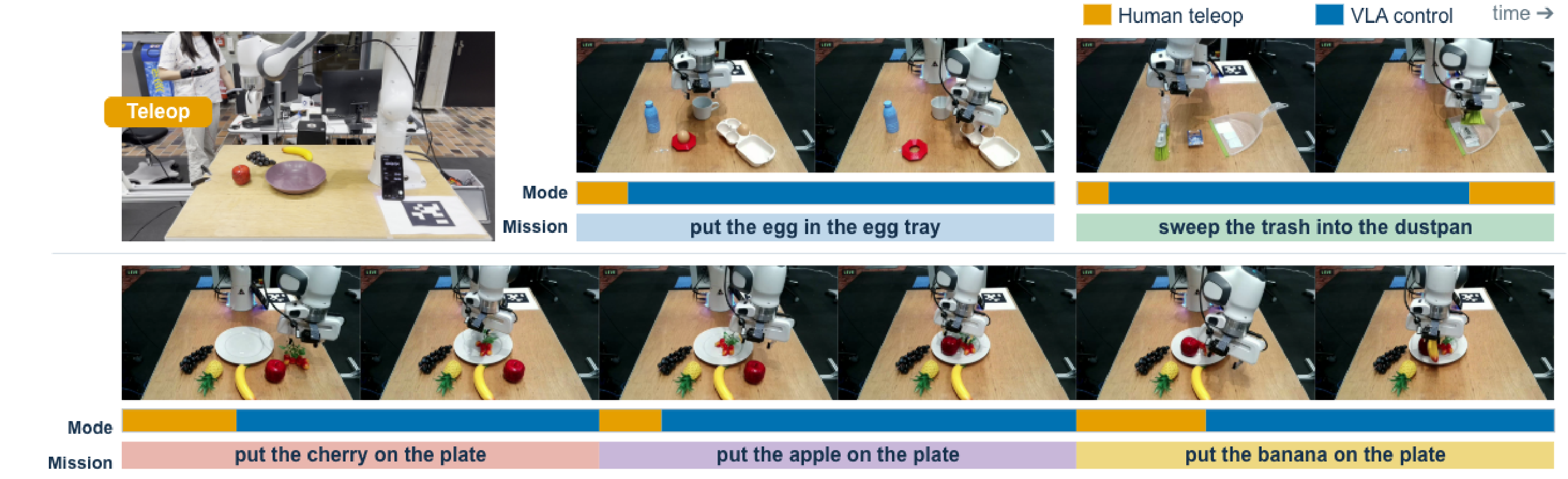
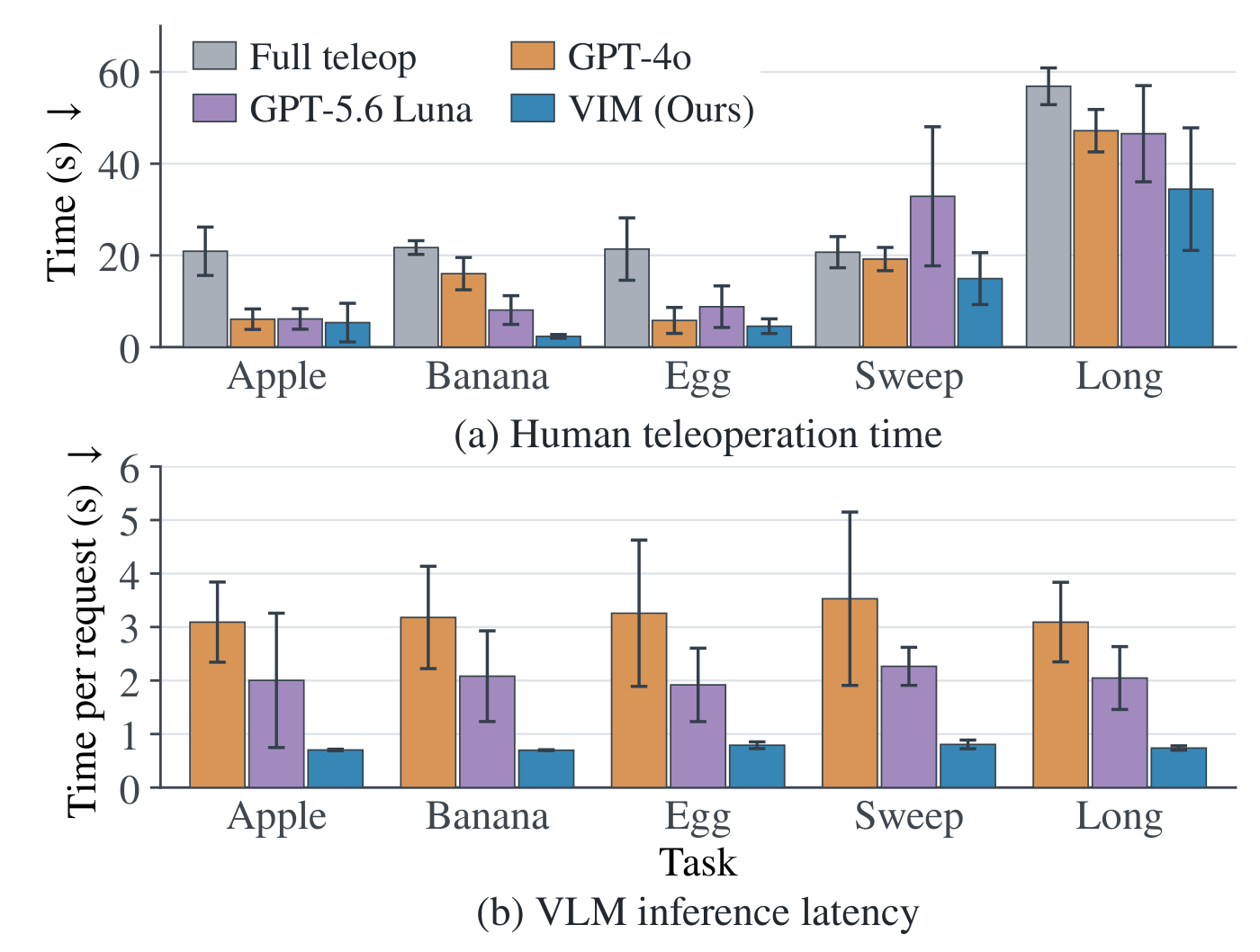
Finally, as a downstream application, VIM’s predicted mission lets a vision-language-action (VLA) policy take over from the operator mid-task in a real-world environment unseen in training, reducing human teleoperation time across five real-world tasks by 34.6% relative to GPT-4o and 39.8% relative to Luna, with the latency reduced by approximately 70% on average.

Video

VI AMO Dataset

6,600 episodes
11 robot sources
13,653 actions
9,702 missions

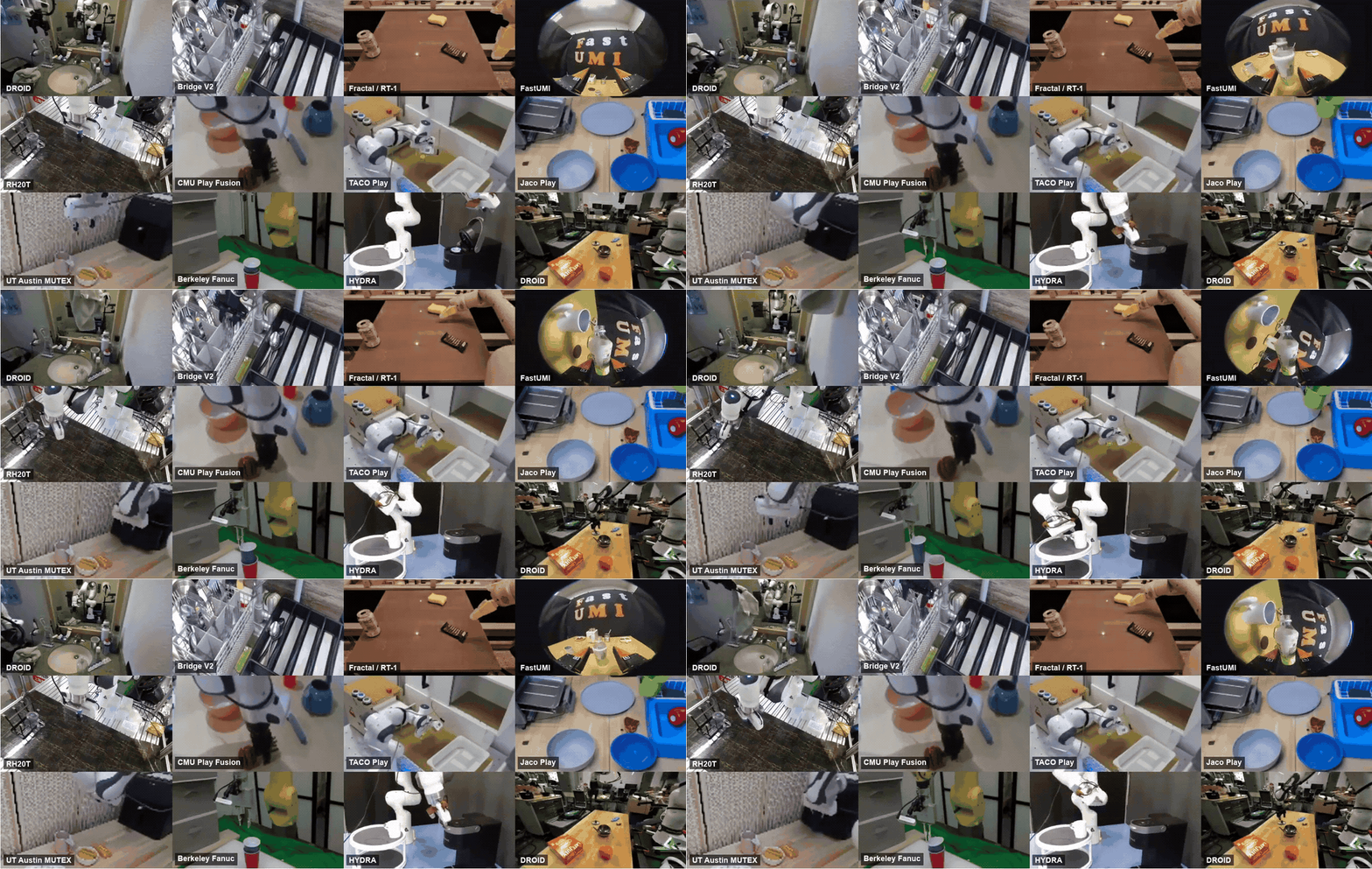
Dataset composition

View source counts
VI AMO source composition
SourceEpisodesActionsMissions
Bridge V23,0914,9503,445
DROID2,0416,3724,452
Fractal / RT-1579656579
TACO Play403403403
CMU Play Fusion224725448
RH20T95224143
Jaco Play686868
UT Austin MUTEX438871
Berkeley FANUC274832
FastUMI2610052
Stanford HYDRA3199
Animated montage of VI AMO demonstrations from eleven robot sources.

OM: Pour the juice into the cup and return the bottle to the coaster.

OA1 · Pick up the bottle
OA2 · Pour the juice into the cup
OA3 · Return the bottle to the coaster
Annotation pipeline, dataset, and VIM training.
Annotation, dataset, and training. Robot demonstrations are annotated with temporally aligned actions and missions. VIM combines visual history with completed-action context to generate the current action and its broader goal.

Intent Prediction Results

Prediction from partial observations

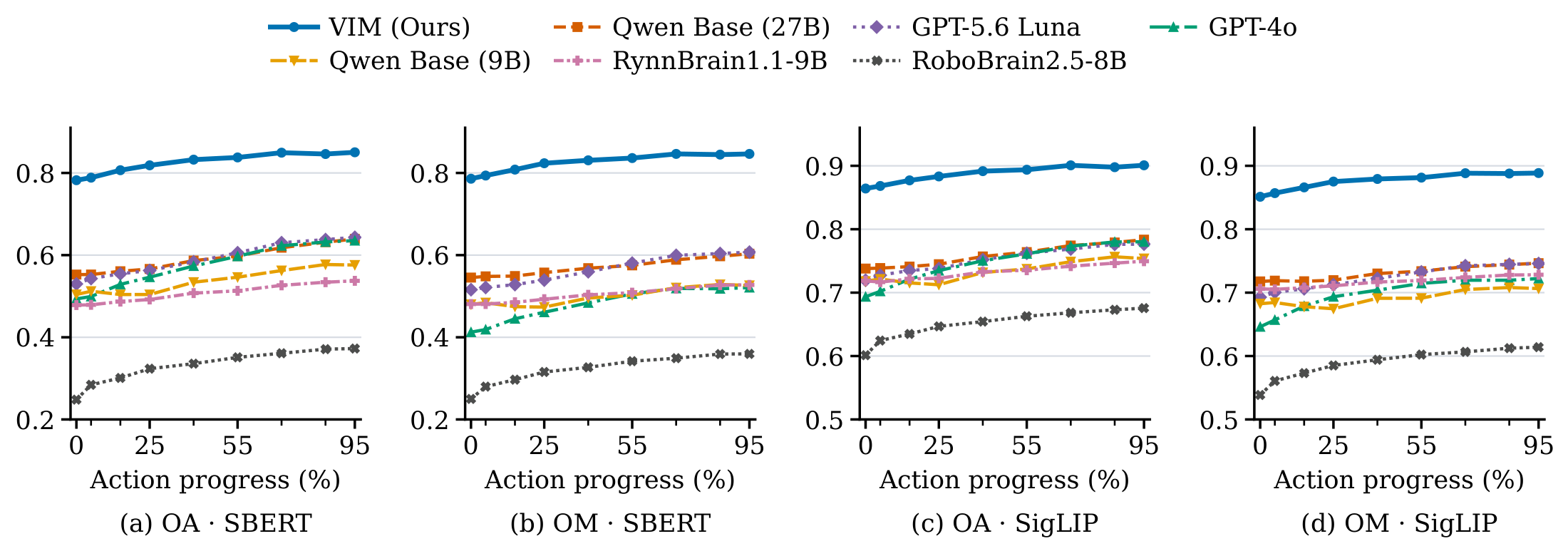
Across nine observation cutoffs spanning 0–95% of an action, VIM achieves higher action and mission similarity than the six baselines under both SBERT and SigLIP. Additional visual history generally improves predictions.

Four plots compare seven models across action progress: ongoing action and mission similarity measured with SBERT and SigLIP. VIM leads across the observation cutoffs.
Intent prediction across action progress. Curves show mean similarity on the VI AMO test set. All models use the same evaluation examples and observation cutoffs; higher is better.

Generalization to unseen labels

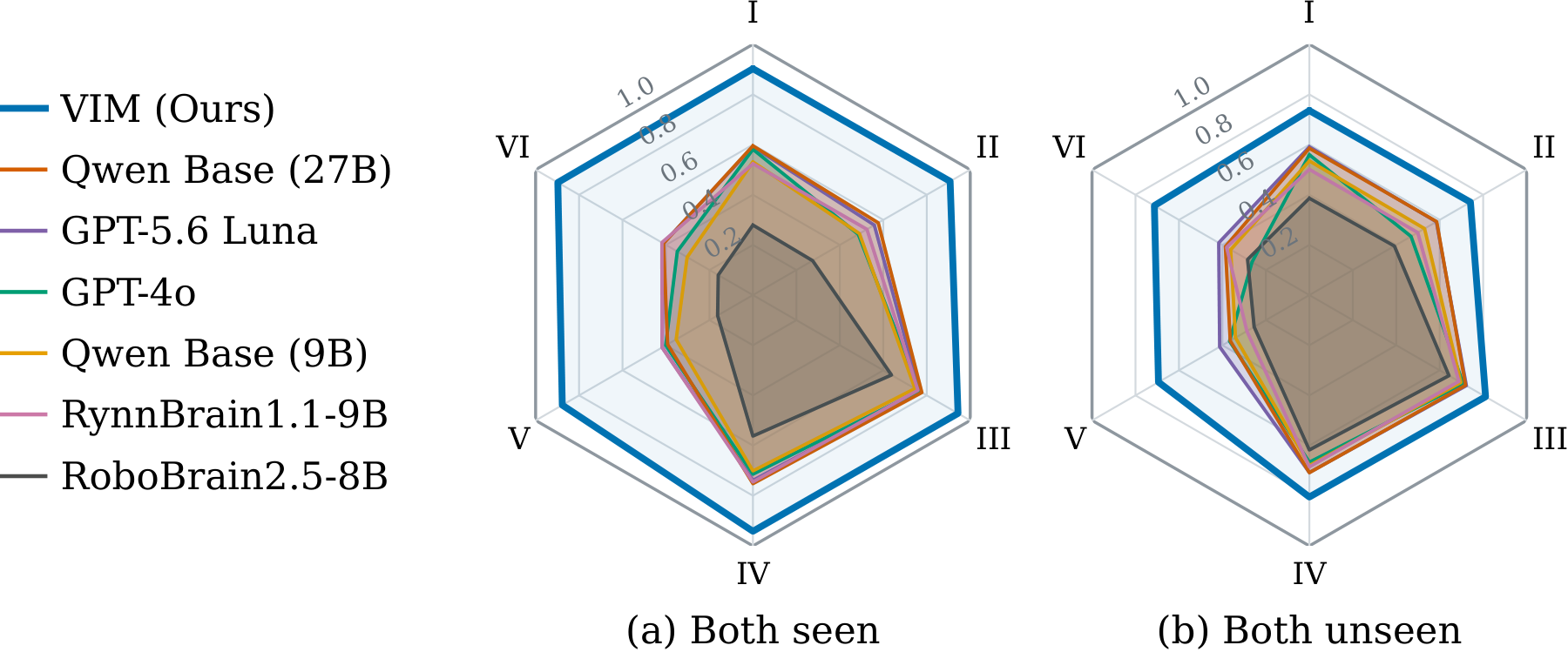
On test actions for which both action and mission labels are absent from training, VIM reaches 0.736 action SBERT and 0.741 mission SBERT. This evaluation measures unseen label strings within the dataset’s source mixture.

Two radar plots compare seven models when both action and mission labels are seen during training and when both are unseen. VIM is the outer blue outline.
Seen versus unseen labels. Clockwise from the top: OA SBERT, OM SBERT, OA SigLIP, OM SigLIP, OA Top-10, and OM Top-10. The blue outline denotes VIM.

Downstream Applications: Shared Autonomy

Human teleopVLA control2× · time →
A human operator starts the robot task through teleoperation.Human-to-robot handoff →
Human teleop

Put the egg in the egg tray

Human teleop

Sweep the trash into the dustpan

Human teleop
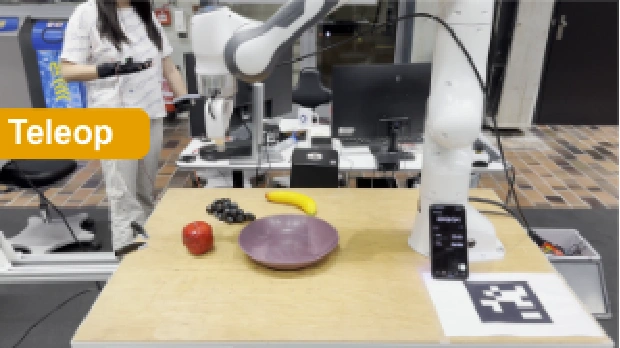
Human-to-robot handoffs. Mission predictions guide continued execution in egg placement, trash sweeping, and multi-mission fruit placement, with mode bars distinguishing human teleoperation from VLA control. The operator initiates a task, confirms the inferred mission, and then hands control to a language-conditioned VLA policy.

Tasks

Real-world task quantitative results

Across five real-world tasks, VIM reduces mean human teleoperation time by 34.6% relative to GPT-4o and 39.8% relative to GPT-5.6 Luna.

Mean VIM inference latency ranges from 0.70 to 0.81 seconds across tasks. The plots report mean ± standard deviation.

Bar charts compare human teleoperation time and VLM latency across apple, banana, egg, sweeping, and long-horizon tasks for VIM and baseline methods.
Real-world quantitative results. Human teleoperation time (top) and inference latency (bottom).

BibTeX